
5-axis milling · hillsborough, new jersey
Home / 5 Axis Milling
Our 5-axis milling services run on a Mori Seiki NTX2000 integrated mill-turn in Hillsborough, New Jersey. It turns to 24″ diameter and 60″ long, with simultaneous 4 and 5 axis milling and drilling on the same machine. The part is held once and the tool reaches the faces instead. Tolerances under .001″ are standard work.
Every time a part comes off one machine and goes onto another, it loses its reference. Somebody re-indicates it and re-fixtures it, and the relationship between yesterday’s features and today’s depends on how well that was done. Five-axis machining removes those handoffs.
A part that needs precision turning and off-centre milling or drilling does not move between a lathe and a mill. Angled cross-holes, eccentric lobes, splines and keyways are cut in the same setup as the turned diameters. Their alignment comes off the machine, not off a second fixturing.
Spiral mandrels, stepped die bodies and feed blocks carry internal geometry and porting that has to line up with the flow. Machining it in a single setup keeps the passages true to one another and leaves fewer places for melt to sit. The extruder components page covers the rest of that work.
Not every part belongs on a 5-axis machine. If a part is cheaper two ways up on a mill, we will tell you and quote it that way. Per hour, a 5-axis machine costs more. Per part, it often costs less, because one setup replaces three or four. Prototypes, single parts and production runs all run on the same machine. Larger milled parts go on our CNC mills, and long shafts go on the lathes.
Parts leave Hillsborough, in Somerset County, for plants across New Jersey: Bridgewater, Somerville, Flemington, Edison, Piscataway and Trenton, and the corridor through Newark, Elizabeth, Jersey City and Paterson. They also go to eastern Pennsylvania, New York and New England, and by truck across the United States, Canada and Mexico.
5-axis work on the shop floor. Click to play.
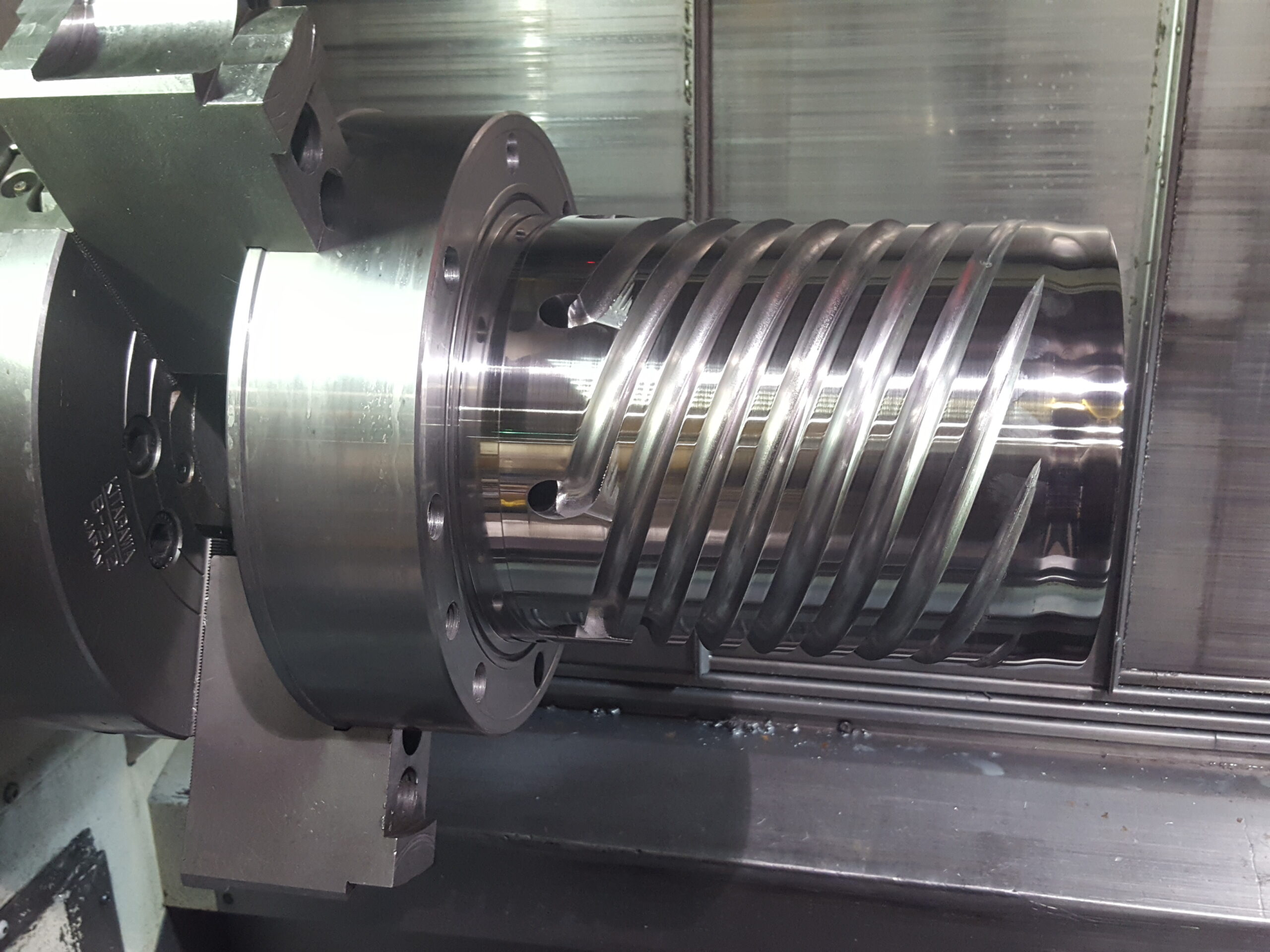
Spiral mandrel for a blown film die, finished on the Mori Seiki.
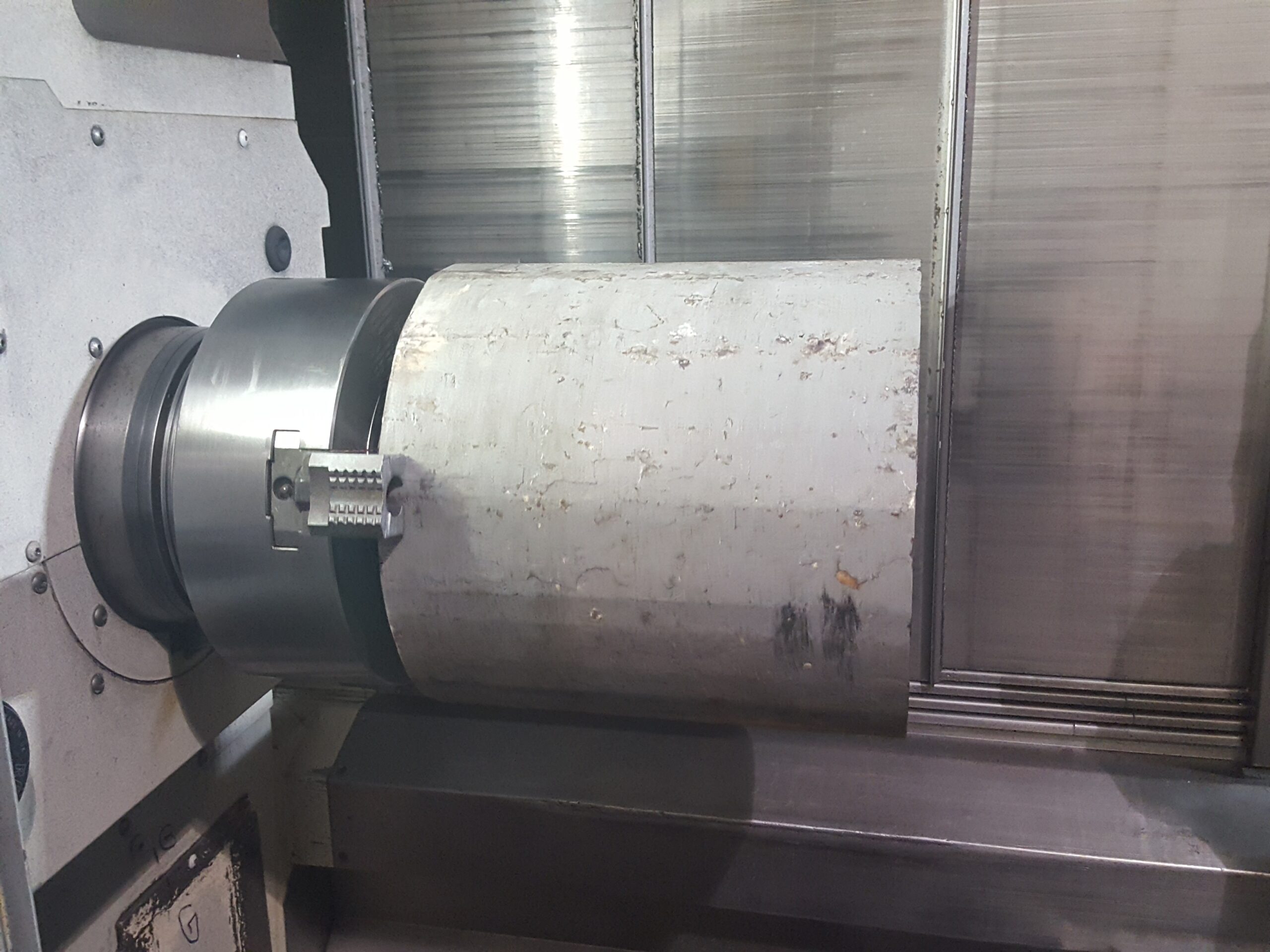
The same mandrel in 4140, held in the machine during turning.
Die bodies and drilled plates cut in single setups on the Mori Seiki mill-turn. More photos and videos are in our gallery.
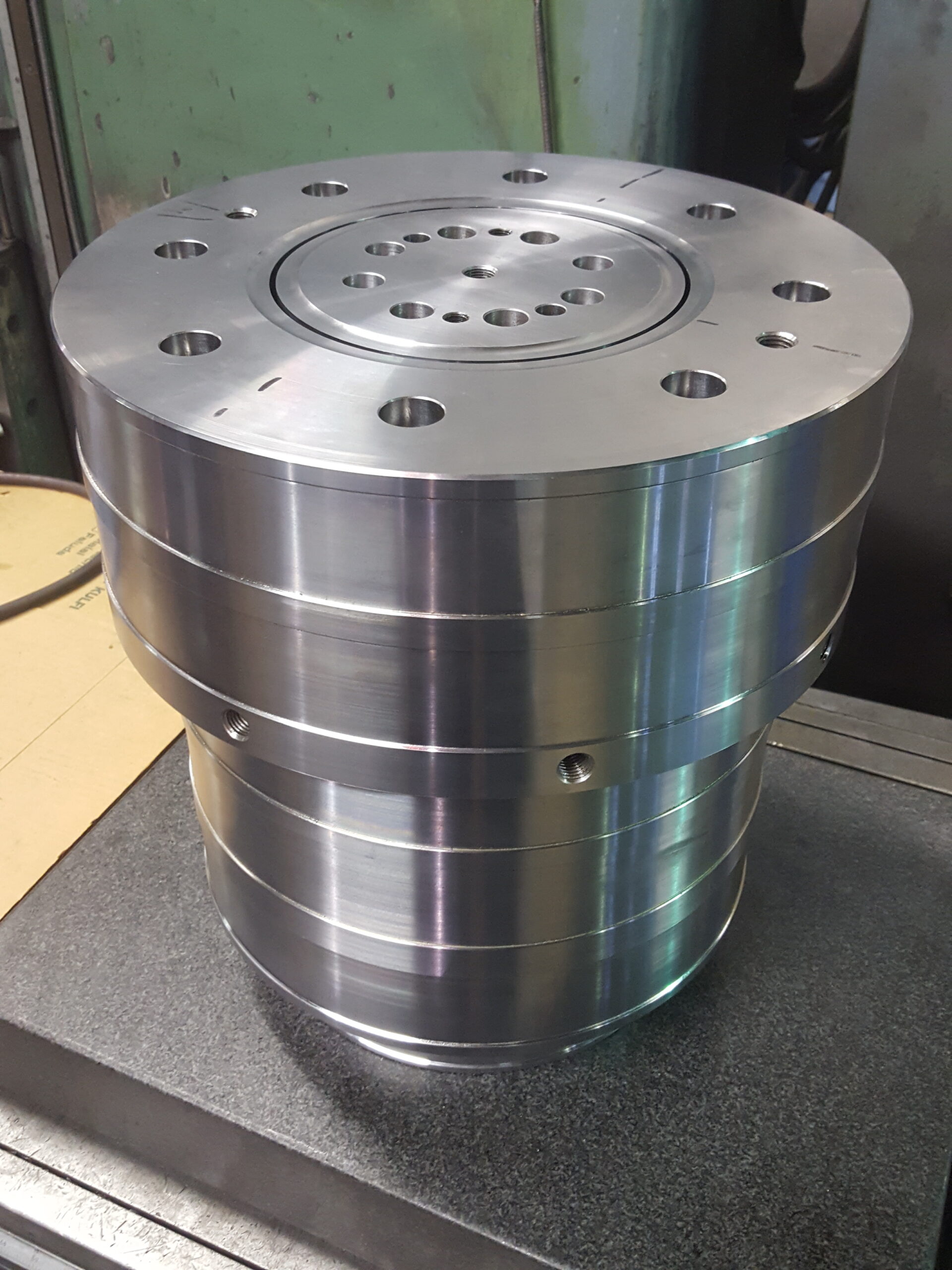
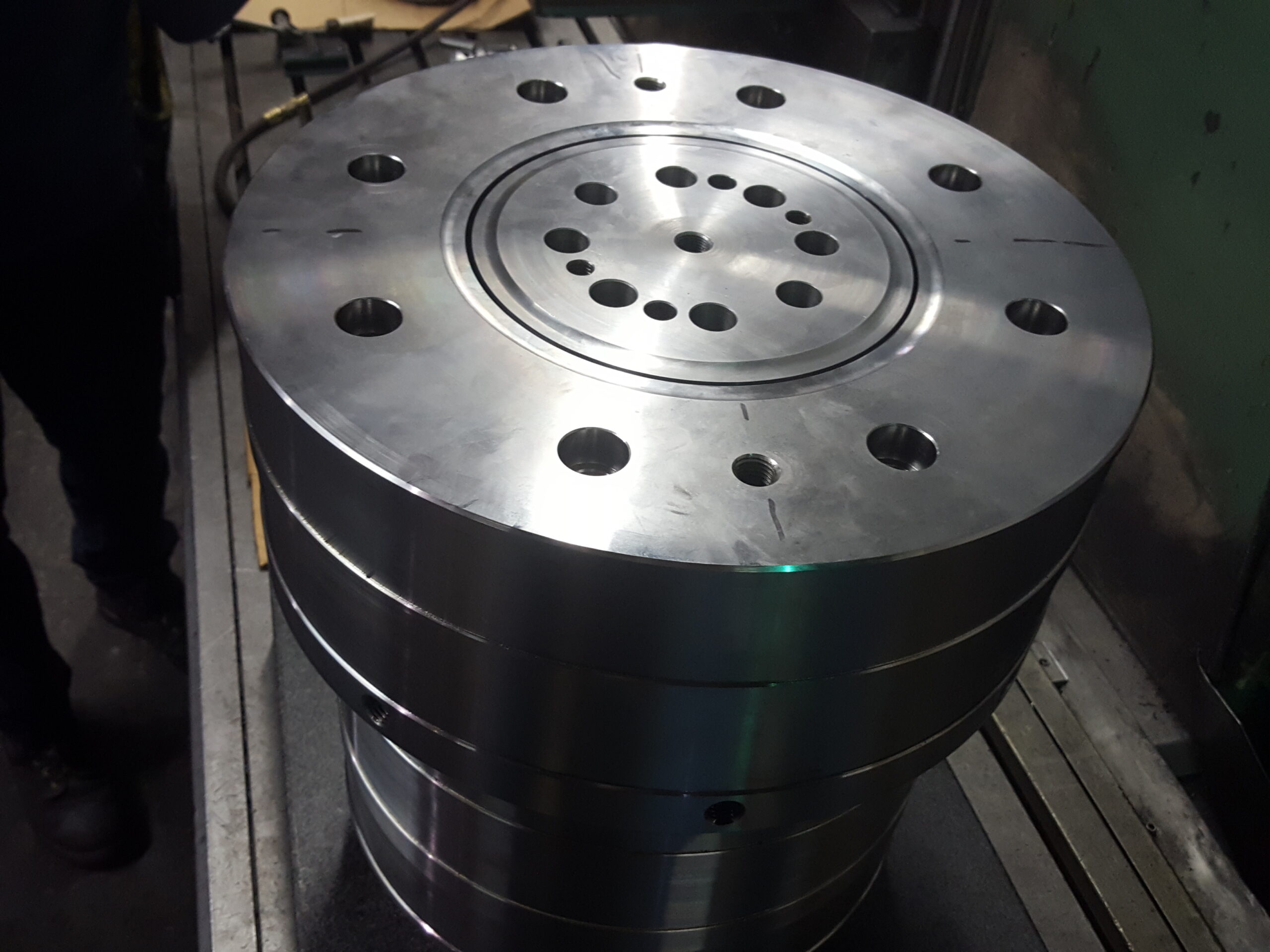
The NTX2000 turns and mills in the same operation, which is what makes it worth putting a part on it.
A part that needs precision turning and off-centre milling or drilling does not have to move between a lathe and a mill.
Angled cross-holes, eccentric lobes and keyways cut in the same setup as the turned diameters stay aligned to the centre line.
Fewer operations mean fewer chances to introduce error and a shorter path across the shop floor.
Polymer extrusion components. Spiral mandrels, feed blocks, adapters and stepped die bodies with porting that has to line up with the flow.
Complex rotary shafts. Shafts with eccentric lobes, splines and keyways, or angled cross-holes cut in true relation to the centre line. Long plain shafts belong on the lathes, where we turn between centres to 170″. See shaft machining.
Drilled and tapped plates. Hole patterns on several faces, cut without re-fixturing.
Aluminium and stainless, including 300 and 400 series, 15-5 PH and 17-4 PH, for structural brackets, food-grade parts and pharmaceutical housings. Alloy steels 4140 and 4340, machined after heat treat where the part has to stay dimensionally stable. Titanium and Inconel, with rigid setups and the right feeds for high-nickel and heat-resistant work.
The programming here is done by people who have run the machines. Three generations of them have worked on this floor. That experience tells you when a print is asking for something that will not hold, or when there is a better way to hold the part.
We machine to what the drawing is asking the part to do, not only to the numbers on it. Send a 3D model and the print together where you have both, since the print carries the tolerances and finishes the model does not. We work from STEP, IGES and SolidWorks files, and from PDF, DWG and DXF drawings.
If you are not sure whether a part belongs on the 5-axis at all, call the shop and talk it through with a machinist.
The mill-turn, and the machines around it for parts that do not fit.
| Machine | Mori Seiki NTX2000 integrated mill-turn |
| Turning | to 24″ diameter × 60″ long |
| Axes | simultaneous 4 and 5 axis — turning, milling and drilling in one setup |
| Features | eccentric lobes, angled cross-holes, splines and keyways, complex porting |
| Tolerance | under .001″ as standard |
| Materials | aluminium, 300 and 400 series stainless, 15-5 PH and 17-4 PH, 4140 and 4340, titanium, Inconel |
| Files accepted | STEP, IGES, SolidWorks, DWG, DXF, PDF |
| Quantity | single parts and prototypes through production runs |
| Beyond the 5-axis | CNC milling to 157″ × 40″ × 70″ on the Zayer; turning between centres to 170″ |
A 5-axis machine moves the tool and the part together so it can reach several faces of a workpiece without the part being unclamped and re-fixtured. You need it when features on different faces have to be in true relation to one another, or when a part would otherwise take three or four separate setups. For a simple prismatic part it is usually not worth it, and we will say so.
The Mori Seiki NTX2000 turns to 24″ diameter and 60″ long. Longer shafts go on the lathes, where we turn between centres to 170″, and larger milled parts go on the Zayer at 157″ × 40″ × 70″.
Yes — that is what the NTX2000 is for. It is an integrated mill-turn, so precision turning and off-centre milling or drilling happen in the same operation, with the part held once.
Yes, splines and keyways are cut in house. Gear teeth are different: we machine the gear blank here — bore, keyways and journals — and a gear-cutting partner cuts the teeth.
Aluminium, 300 and 400 series stainless, 15-5 PH and 17-4 PH, 4140 and 4340 alloy steel including work after heat treat, titanium and Inconel.
STEP, IGES and SolidWorks models, and PDF, DWG and DXF drawings. Send the model and the print together where you have both — the print carries the tolerances and finishes the model does not.
Per hour, yes. Per part, often not. A part that takes four setups on conventional machines carries four fixturings, four chances to lose the reference and four lots of handling. Send the drawing and we will quote it the way that actually costs less.
Hillsborough, New Jersey, in Somerset County — an easy drive from Bridgewater, Somerville, Flemington, Edison, Piscataway and Trenton, and from the corridor through Newark, Elizabeth, Jersey City and Paterson. Parts also go by truck across the United States, Canada and Mexico.
Most 5-axis parts also need turning, larger milling, honing or drilling. These are the services around the mill-turn.
Send the model, the print and the quantity, and we will quote it the way that costs less. Call the shop or email sales@zalamachine.com, or use the quote form below.