
industrial gearbox repair · hillsborough, new jersey
Home / Industrial Gearbox Repair
Industrial gearbox repair here is done by a machine shop, not by a shop that orders parts and bolts them back in. When a component is obsolete or the OEM quotes twenty weeks, we make it. Gear blanks, shafts and housings are machined here; our gear-cutting partner cuts the teeth. Single-screw or twin-screw, lab-scale or large production, the job is the same: find why it failed, restore the housing bores, and time the gear train properly on the way back together.
Most repair shops are assembly houses: they order parts and wait. Zala is a manufacturing facility. If your gear is stripped and the OEM quotes six months, we make the replacement instead of chasing it — and because the machining, fitting and timing are ours, the schedule stays under our control. When the box is down now, that becomes emergency machining.
Extruder gearboxes are what we are best known for. They are not the limit of it. We rebuild gear reducers and industrial gearboxes of most kinds — helical and bevel-helical, worm, planetary, parallel shaft and right angle, single-screw and twin-screw extruder drives among them. The discipline is the same whatever the box drives: strip it, measure it, work out why it failed, make what cannot be bought, and put it back together right.
Bring us a complete unit or a single component. We work from either. If a gear, shaft or housing is obsolete, we measure the worn part and make a new one from that.
On twin-screw work we have gone further than most shops. Zambello invited us to their factory in Italy, where we spent two days training on their gearboxes, twin-screw units in particular.
Where we start depends on the drive:
Single-screw gearboxes: thrust bearing condition and axial load path.
Twin-screw gearboxes: shaft alignment and timing, co-rotating or counter-rotating.
Capacity: we lift to 10 tons and line-bore to 20″ diameter across a 50″ span, in house. That covers lab-scale units through large production gearboxes.
Turnaround: one to two weeks for bearings and seals, and six to ten weeks for a full rebuild. Either way the box is back on your floor before a replacement unit would have arrived.
The three panels beside this text are jobs from our own shop, made from our own photos. The first shows a gearbox taken from broken and contaminated to fully restored. The second shows a housing whose worn bores were built up with weld and machined back to size. The third follows a twin-screw box from teardown and inspection through to assembly.
Housing bores are where many repairs succeed or fail. A worn bore lets the bearing move, and the gears lose their contact pattern. We build the bore back up and line bore it to size on our own machines, so the shafts sit where they were designed to sit.
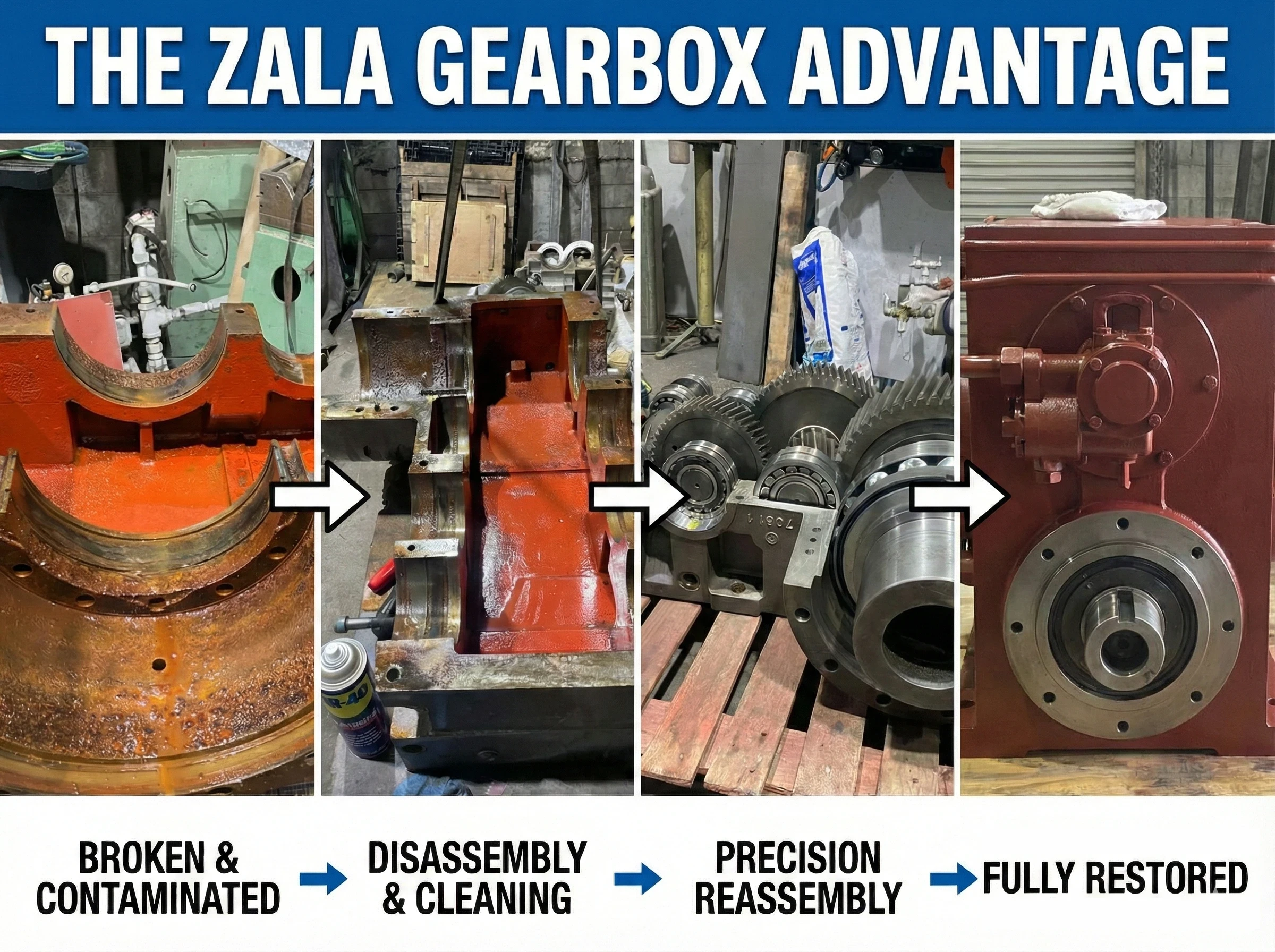
From broken and contaminated to fully restored: the four stages of a gearbox repair.
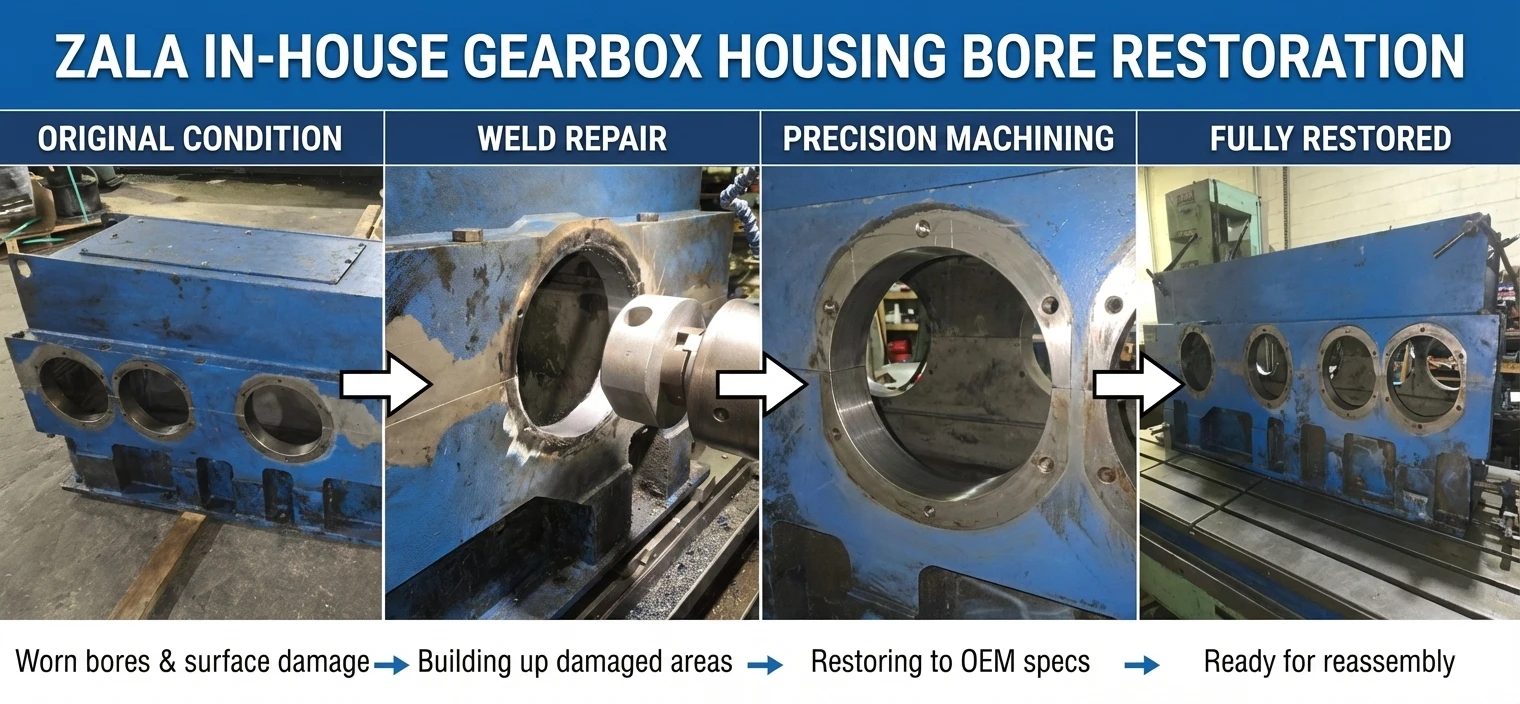
Housing bore restoration in house: weld repair, then precision machining back to size.
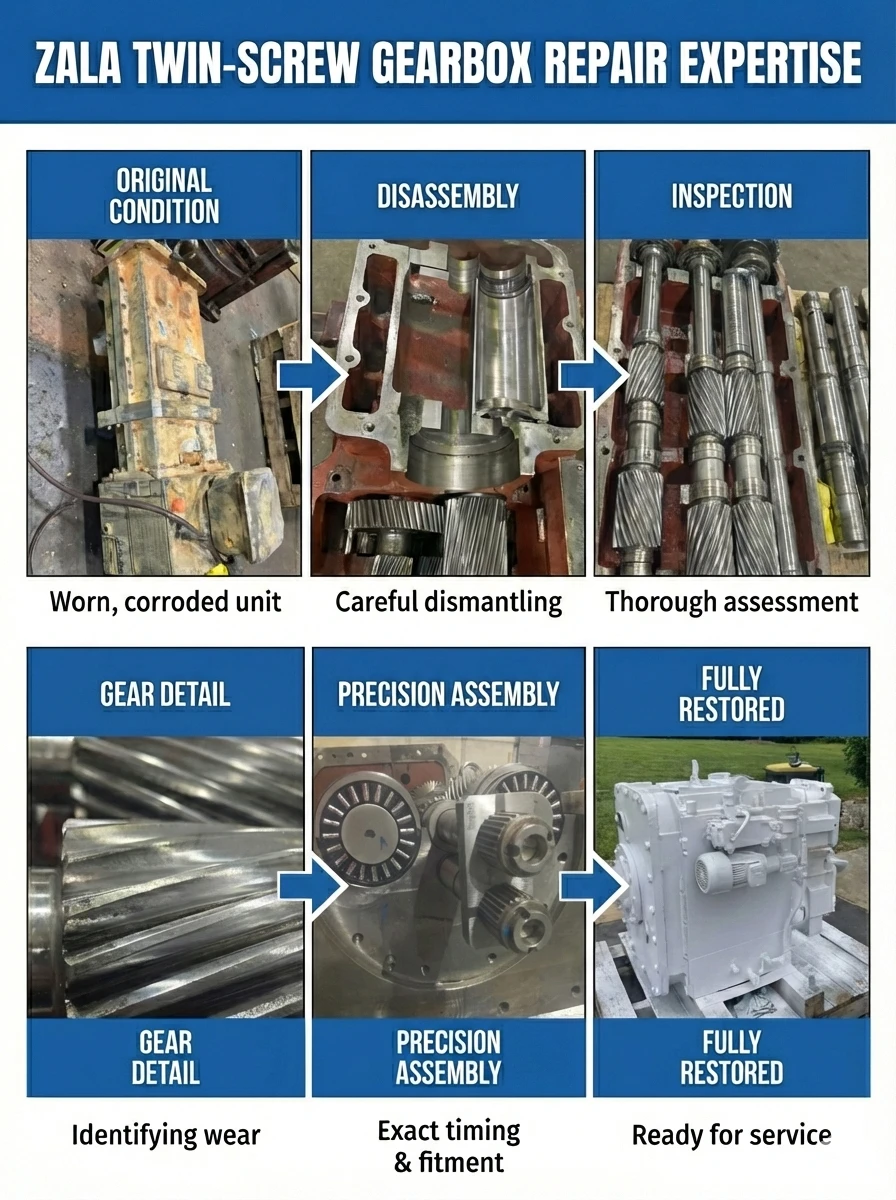
A twin-screw gearbox from teardown and inspection through to assembly.
Teardown, inspection and rebuild of high-torque industrial gearboxes — failure analysis, line boring and re-timing carried out in house in Hillsborough, New Jersey.

Twin-screw extruder gearbox opened for inspection. Helical gear sets and bearings checked for wear, pitting and backlash before the rebuild is quoted.
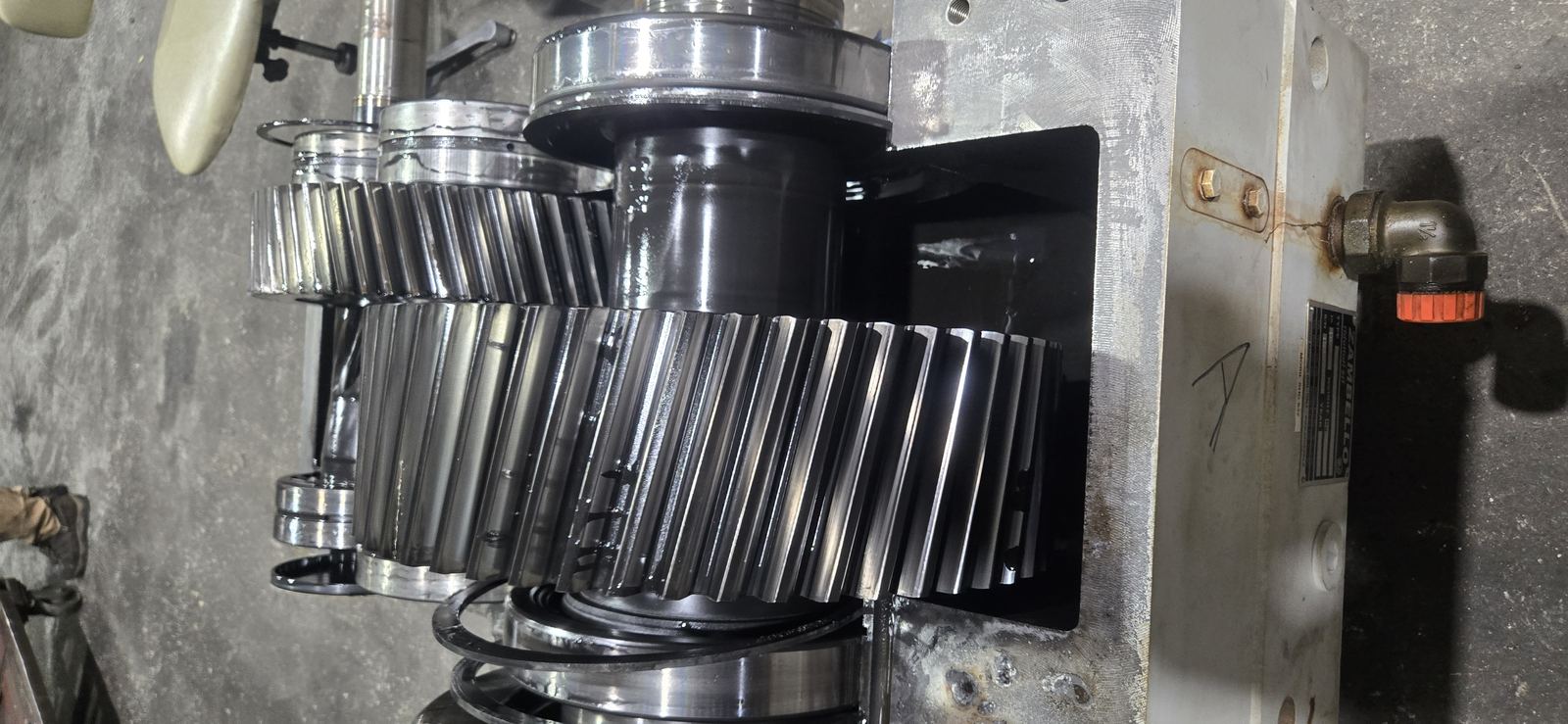
Gear stack removed and measured. Tooth contact, journal diameters and bore fits recorded against the original build spec.
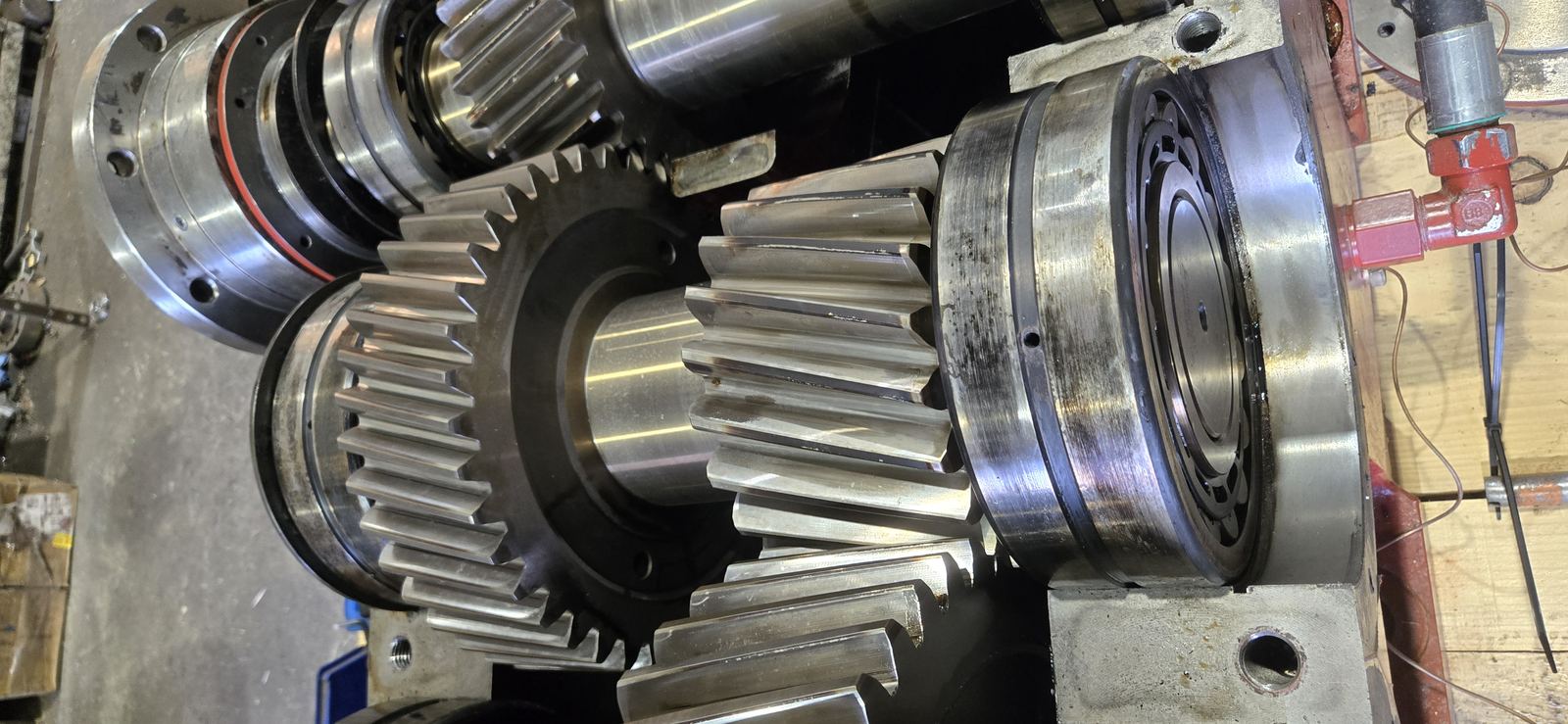
Spherical roller bearings replaced and gear mesh reset. Worn journals are reground or sleeved so new bearings seat correctly.
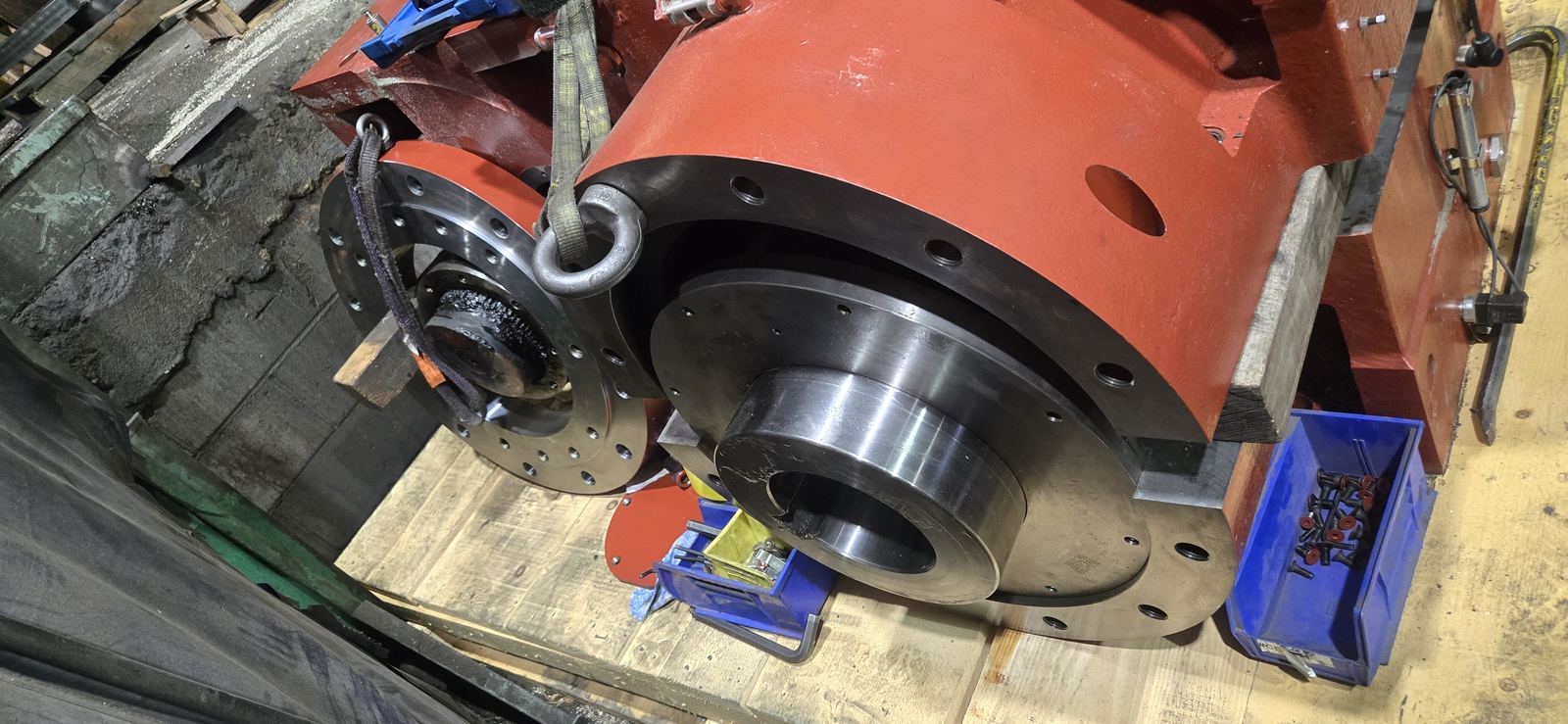
Bearing bores line-bored back to size in the housing, restoring shaft alignment across the case before reassembly. All machined in house.
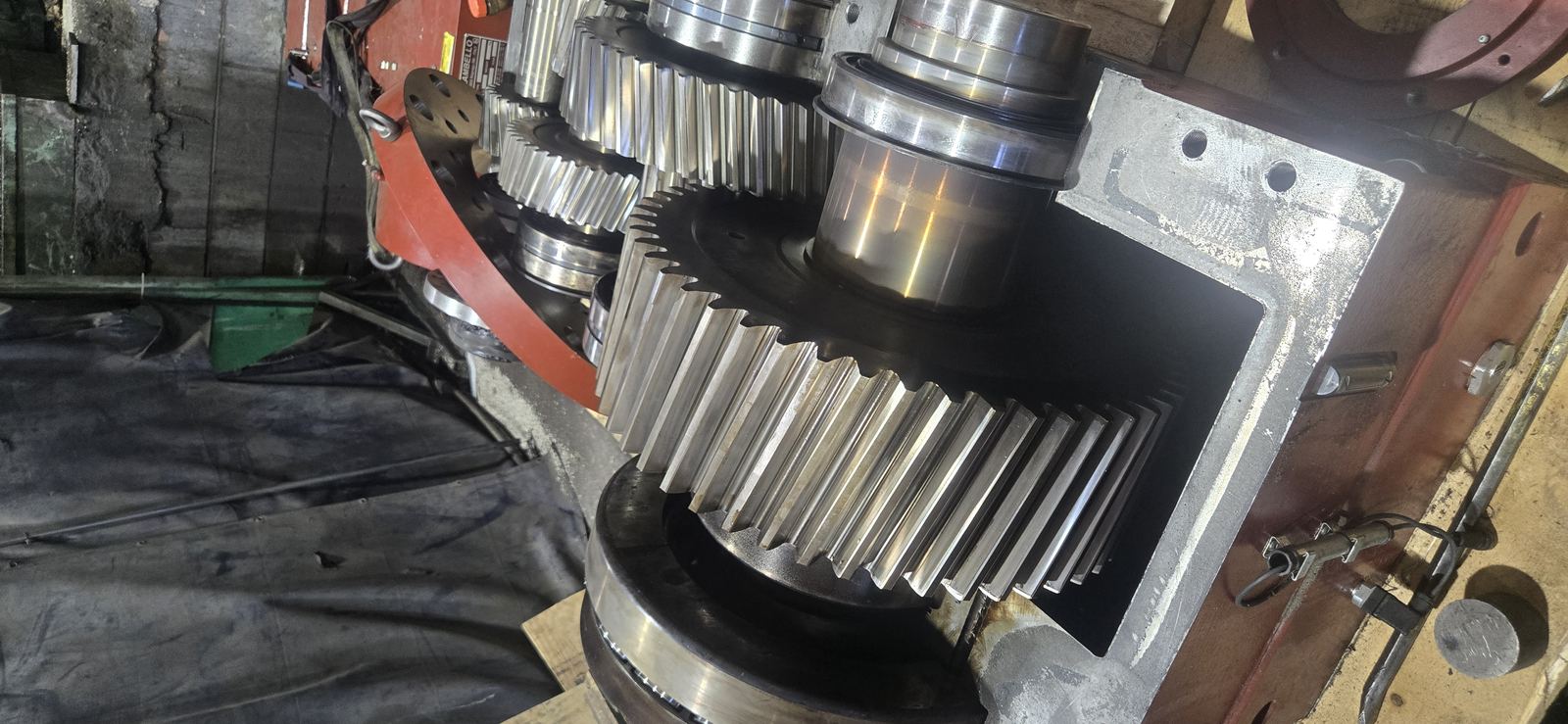
Gear train reassembled in the case and re-timed, with backlash and contact pattern checked on each mesh.
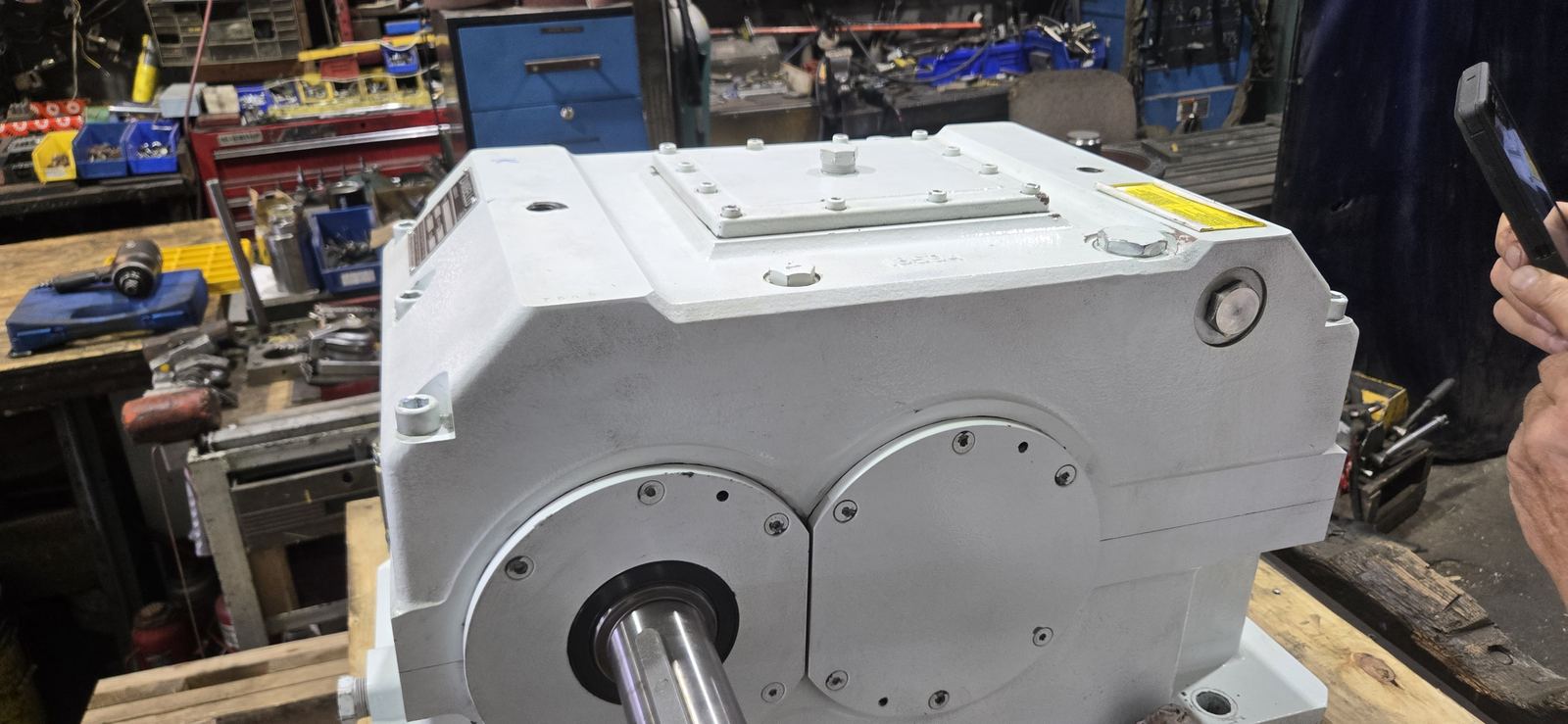
Rebuilt extruder gearbox closed up and painted, ready to go back on the line.
Every gearbox goes through the same five steps, and each one is documented.
The unit is cleaned and degreased before anything comes apart. Years of production buildup hides cracks and weeping seals, and it contaminates every part you pull out of the case.
We record the orientation and position of every gear, shaft and shim as it comes out. Shim stacks and gear positions are what tell you why the box failed. Lose that record and you are guessing.
Every component is measured on a Keyence portable CMM and with bore gauges, ID mics, depth mics and groove mics. We inspect:
Gear Teeth: Checking for pitting, spalling, or micro-cracking.
Shafts: Checking for runout, wear at bearing seats, and seal surface integrity.
Bores: Checking for ovality or wear in the main housing bores.
If a part is obsolete or carries a twenty-week lead time, we reverse-engineer it from the worn component and make it.
Gear manufacturing: we machine the gear blank, and our gear-cutting partner cuts the teeth.
Housing repair: worn bearing seats sleeved and line-bored on our boring mill, restoring shaft alignment across the case.
Shaft recovery: bearing and seal diameters ground back to size in house. Where a shaft needs building up first, plating goes to our plating vendor and we finish it here. Shaft work has been a cornerstone of this shop since day one.
The box is reassembled with new bearings and seals. Runout, backlash and the tooth contact pattern are checked on every mesh. On twin-screw units the gear train is re-timed and those checks repeated before the case is closed. Final dimensions are recorded against the original build spec.
A blown film producer in California had a gearbox that could not be supported any longer — no parts, no replacement, and an OEM with nothing to offer. The whole line was built around it. We machined a new large mounting plate and a gearbox-to-extruder adapter so a new Zambello heavy-duty single-screw box could take its place on the existing frame. The customer kept the line and the extruder, and changed the one part that had become unobtainable.
Turning to 60″ diameter and 170″ between centres. Milling to 157″ x 40″ x 70″. Honing to 26″ bore and 120″ long. Gundrilling to 4″ diameter, 96″ deep. Carbon and alloy steel, stainless, 4140HT, Inconel, titanium and bronze.
Most of our gearbox work comes from plants in New Jersey and across the northeast, and we take boxes from anywhere. Every county in New Jersey is an easy drive from the shop in Hillsborough, and so is the industrial corridor through Newark, Elizabeth, Jersey City, Paterson and Fairfield.
Beyond that we have shipped repaired and newly made gearbox components across the country, and we quote work from South America — inquiries from Chile and Colombia are routine.
A repair puts right what failed. A rebuild strips the unit completely, replaces bearings and seals, restores or replaces worn gears, shafts and bores, and reassembles it to the original build spec. An overhaul is the same work on a unit that is still running but is due. We quote whichever the box actually needs after we have opened it, not before.
Yes. Gear reducers, speed reducers and industrial gearboxes of most kinds — helical and bevel-helical, worm, planetary, parallel shaft and right angle. The extruder work is what we are known for, not what we are limited to.
Six to ten weeks. Bearings and seals sit at the short end; having to make gears sits at the long end. Either way the box is back before a replacement unit would have shipped.
Either. Send the complete unit or send the broken component. If the part is obsolete we measure what is left of it and make a new one.
Yes. We machine the blank here — bore, keyways and journals — and our gear-cutting partner cuts the teeth, with the schedule for the whole job held by us.
Runout, backlash and the tooth contact pattern on every mesh. Twin-screw units are re-timed and re-checked. Final dimensions are recorded against the original build spec.
Yes, single-screw and twin-screw. We also make the adapters and mounting plates that join the gearbox to the extruder, including for a replacement box on an existing frame.
All of New Jersey and the northeast as our home ground, and gearboxes from anywhere else. We have made components for lines as far away as California and we quote work into South America.
A gearbox rebuild draws on most of the shop: turning, milling, line boring, grinding and inspection. Each of those has its own page.
Call the shop or email sales@zalamachine.com with the nameplate and a photo. You can also use the quote form below, or download our capability statement (PDF).