
large vertical turning · hillsborough, new jersey
Home / Large Vertical Turning
Our large part vertical turning services run in Hillsborough, New Jersey, alongside long-bed lathe work between centres. The CNC lathes here turn to 28″ diameter; anything bigger goes to the large manual turning department. Two Giddings & Lewis vertical turret lathes turn to 60″ diameter. A Poreba horizontal lathe takes 32″ diameter and 170″ between centres, and a Tur takes 26″ by 160″. That is the capacity most shops in the region turn away, and it is why a lot of the large parts in this state end up here.
A hub, a flange, a ring or a housing that will not fit a 28″ chuck is not a problem here — it is the everyday job of the vertical lathes. A vertical turret lathe holds the part on a horizontal table and cuts from above, which is the right way to turn something wide, heavy and short: the weight sits on the table instead of hanging off a chuck, and the bore and the face come out square to one another because they are cut in the same setup. We lift to 10 tons.
Long work runs between centres on the Poreba, to 32″ diameter and 170″ long, with a taper attachment for tapered journals and seats. The Tur takes 26″ diameter to 160″ long and is the more precise of the two for large, finely toleranced work. Between them they cover drive shafts, rotor shafts, rolls and long cylinders that have to be straight over their whole length and run true at both ends. Shaft grinding is in house for the bearing diameters, and the shaft page covers that side in detail.
Castings and forgings rarely arrive round, square or consistent from one to the next, and that is where manual turning still earns its place. The machinist sets the part up to the surfaces that matter, adjusts as the cut reveals what the casting actually is, and brings the bore or the face true to the datum on the print rather than to whatever the foundry left. Heavy-walled housings, gear blanks, pump casings and large flanges are the typical parts.
Large turning on the shop floor. Click to play.
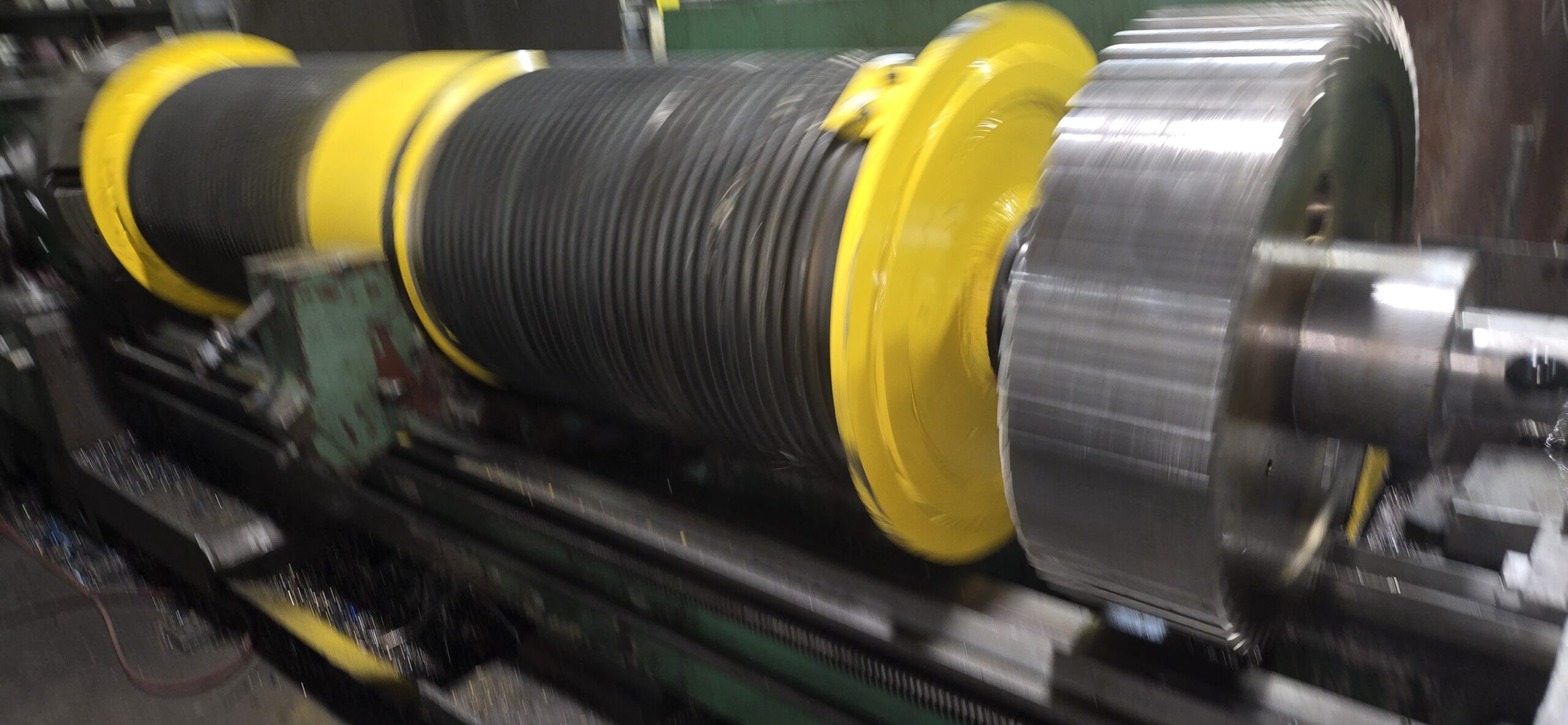
Grooved cable drum for a shipyard crane, machined on the large lathe.
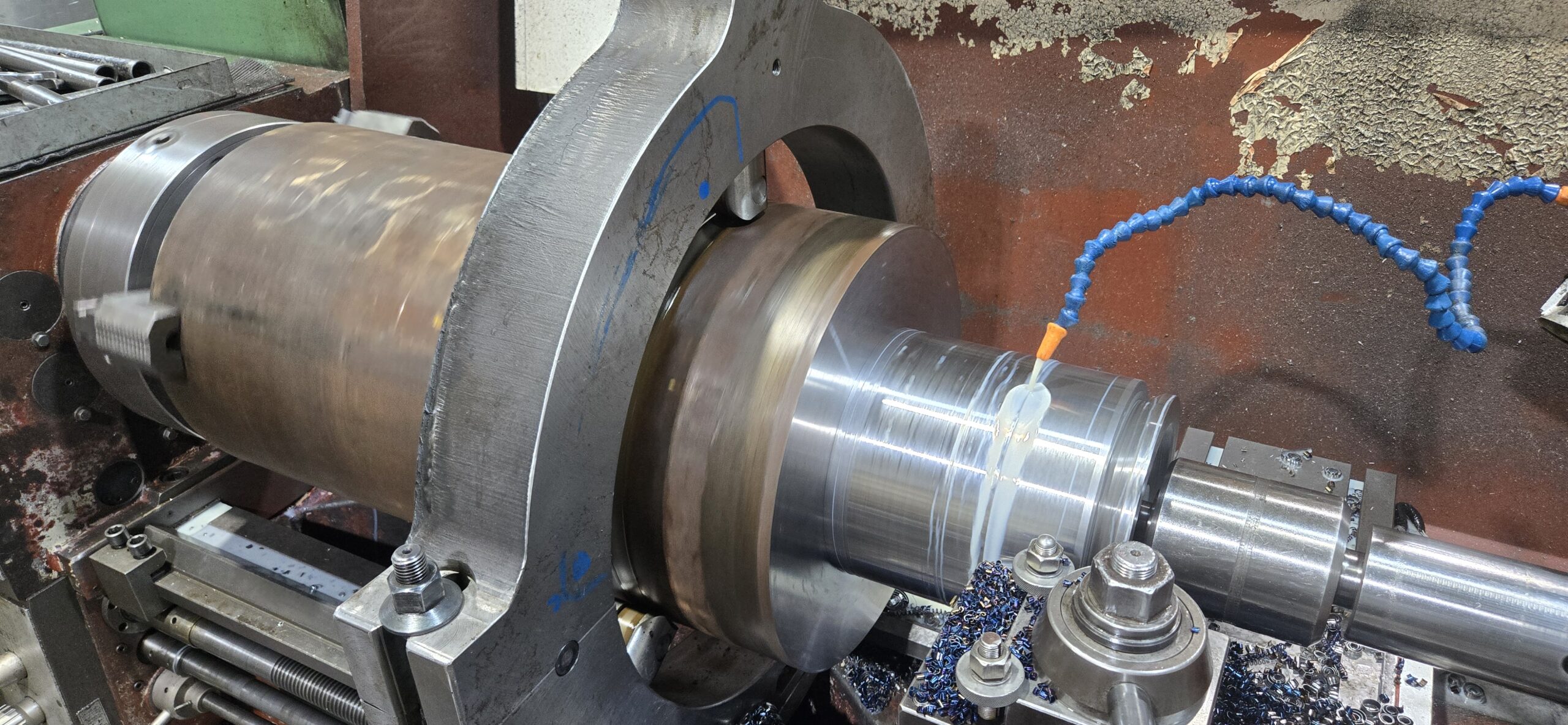
Large-diameter bore machined with coolant on a horizontal lathe.
Four manual lathes make up the large turning department. The two vertical turret lathes take the wide, heavy work; the two horizontal lathes take the long work. All four are run by machinists who have spent years on them.
60″ maximum turning diameter. Large housings, castings, forgings, hubs, flanges and rings, with the bore and face cut in one setup.
32″ diameter and 170″ between centres, with a taper attachment for tapered journals and seats.
26″ diameter by 160″ long. The more precise of the two for large, finely toleranced work.
A lot of what goes on the large lathes is repair. Worn journals on a shaft that is no longer made, a bore in a housing that has gone oval, a roll face that has picked up damage — the part comes in, we measure it, and we machine it back to size or make a new one from the old one. Where there is no drawing, we reverse engineer it. For the parts that hold up a line, the emergency machining page explains how fast this can move.
CNC is the right answer for repeat parts. It is not always the right answer for a one-off casting, a worn part that is no longer round, or a forging that needs roughing in before anybody knows exactly where the good material is. On those jobs the machinist is adjusting as the cut goes, and that adaptability is what the large manual department is for. It is also why oversized repair work — the shaft that is not made any more, the housing that would cost a fortune to replace — keeps coming back to these machines.
The large manual lathes, the CNC lathes and the finishing around them.
| Vertical turning | to 60″ diameter — two Giddings & Lewis vertical turret lathes |
| Horizontal turning | 32″ diameter × 170″ between centres (Poreba, with taper attachment); 26″ × 160″ (Tur) |
| CNC turning | to 28″ diameter × 60″ long; 14″ × 83″ long |
| Lifting | to 10 tons |
| Typical parts | hubs, flanges, rings, housings, gear blanks, pump casings, drive and rotor shafts, rolls, long cylinders |
| Finishing in house | shaft grinding, bore honing to 26″ ID, line boring to 20″, welding and polishing |
| Materials | carbon and alloy steel, 4140 HT, stainless, cast iron, bronze, Inconel, titanium |
Large parts are awkward to ship, so most of this work is regional: plants across New Jersey — Bridgewater, Somerville, Flemington, Edison, Piscataway and Trenton, and the industrial corridor through Newark, Elizabeth, Jersey City and Paterson — plus eastern Pennsylvania, New York and New England. Customers in Somerset, Hunterdon, Middlesex and Mercer counties often bring the part in on their own truck. Further afield, parts go crated across the United States, Canada and Mexico. Send the print and the weight and we will tell you how we would hold it.
Vertical turning to 60″ diameter on two Giddings & Lewis vertical turret lathes. Horizontal turning to 32″ diameter and 170″ between centres on the Poreba, and 26″ by 160″ on the Tur. We lift to 10 tons. If your part is near any of those limits, send the print and the weight and we will tell you how we would hold it.
A vertical turret lathe holds the part on a horizontal rotating table and cuts from above. For a wide, heavy, short part — a hub, a flange, a ring, a housing — that is the right way round: the weight sits on the table rather than hanging off a chuck, and the bore and the face are cut in one setup so they come out square to each other.
Manual. The CNC lathes here turn to 28″ diameter and handle the repeat work. The four large lathes are manual, run by machinists who have spent years on them, which is exactly what a one-off casting, a worn repair part or a heavy forging needs.
Yes, and a good share of this work is exactly that. Castings and forgings are set up to the surfaces that matter and machined true to the datum on the print rather than to whatever the foundry left. Heavy-walled housings, gear blanks, pump casings and large flanges are typical.
Yes. Worn journals, oval bores, damaged roll faces — the part comes in, we measure it and machine it back to size, or make a new one from the old one when there is no drawing. For large parts that are no longer made, this is usually far cheaper than replacing the equipment.
Yes. Shaft grinding, bore honing to 26″ ID, line boring to 20″, welding and polishing all happen in this building, so a large part is not shipped between shops between operations.
Carbon and alloy steel, 4140 HT, stainless, cast iron, bronze, Inconel and titanium among others. Tell us the material with the print and we will source it, or machine stock you supply.
Hillsborough, New Jersey, in Somerset County. Large parts are awkward to ship, so most of this work comes from New Jersey, eastern Pennsylvania, New York and New England, and customers often bring the part in on their own truck. Further afield, parts go crated across the United States, Canada and Mexico.
Large turned parts are usually milled, bored, honed or ground here as well. These pages cover that work.
Send the print and the weight and we will tell you how we would hold it. Call the shop or email sales@zalamachine.com, or use the quote form below.