
Extruder breaker plates
Home / Extruder Breaker Plates
Our extruder breaker plates are machined for single and twin-screw extruders, to your drawing or from the worn plate you send us. Every hole is drilled here on our own machines, with high-pressure coolant through the drill.
A breaker plate carries the screen pack, builds head pressure and turns the rotating flow coming off the screw into straight flow into the die. It works hot, under pressure, with the screens pressed against it. The face has to stay flat and the holes have to stay clean.
We make them as one-offs and in sets: flat plates, stepped plates, domed plates, plates with counterbored screen seats, and plates for screen changers. Hole patterns, open area, counterbores and locating features are machined to your drawing. If there is no drawing, send us the old plate and we will measure it.
Every CNC machine on our floor runs a high-pressure coolant pump, and we drill with through-coolant carbide drills. Coolant reaches the cutting edge at the bottom of the hole and pushes the chips straight back out, so the holes come out clean and on size instead of tapered and rough-walled.
That matters on a breaker plate, where every hole has to match the last one. We have drilled plates with up to 1,600 holes.
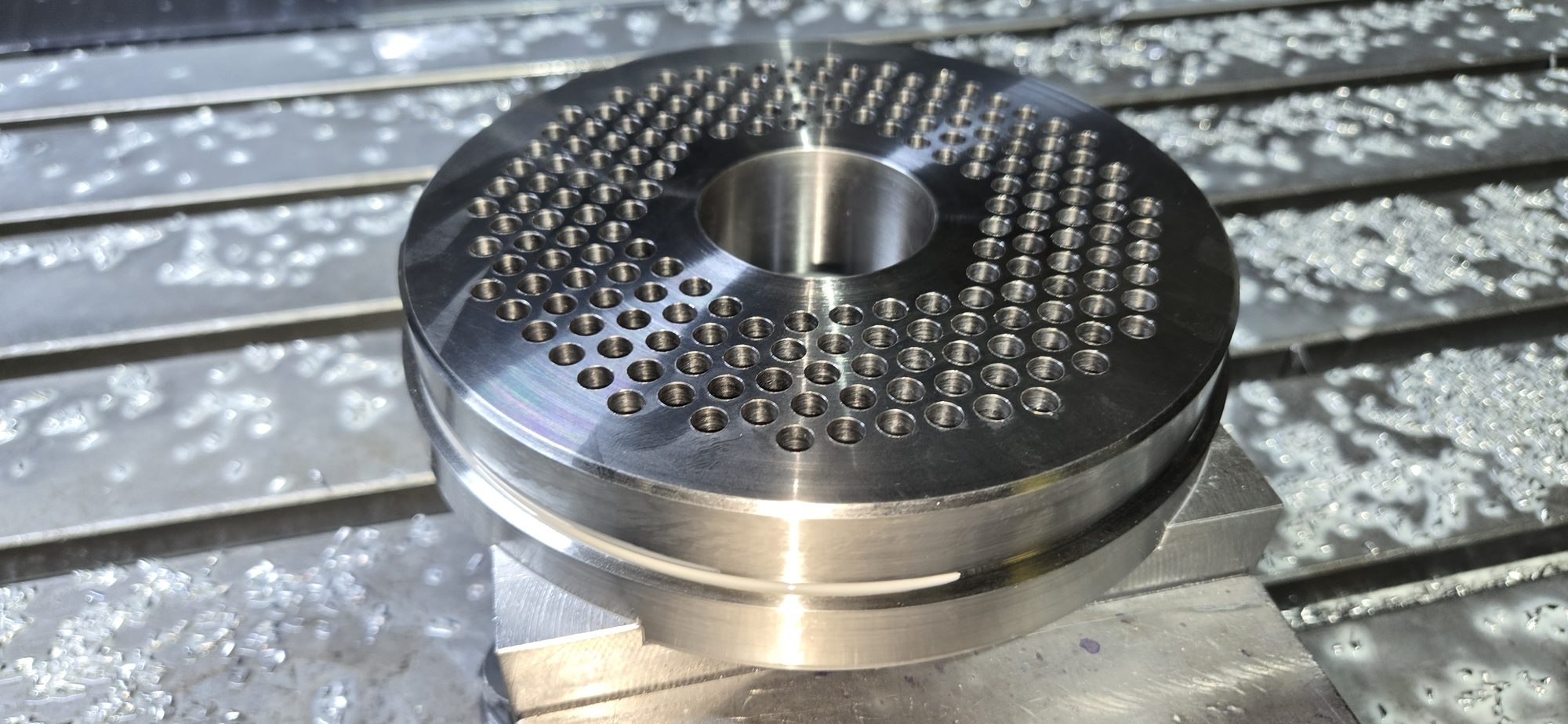
Breaker plate drilled on the CNC mill, even hole pattern around the centre bore.
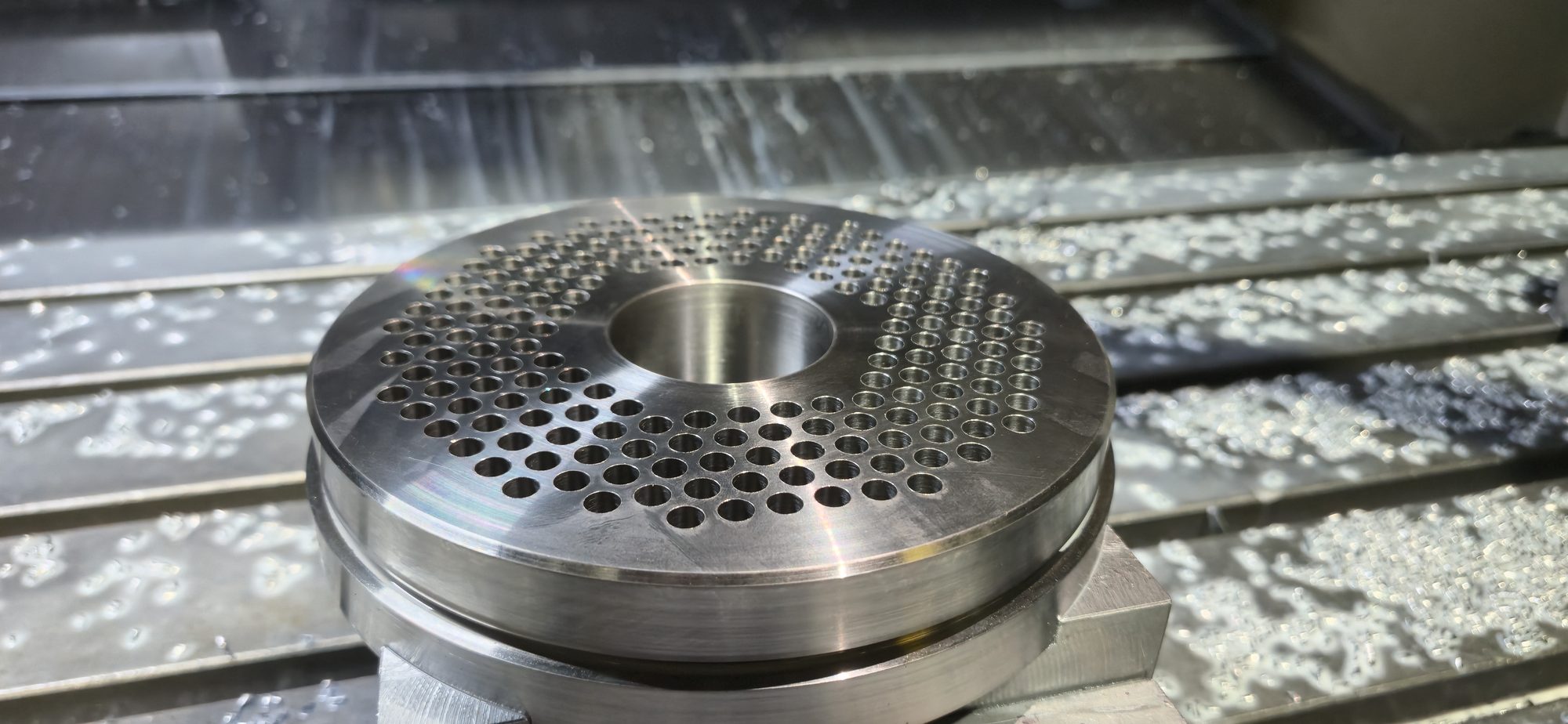
Holes drilled with through-coolant carbide drills, chips still on the table.
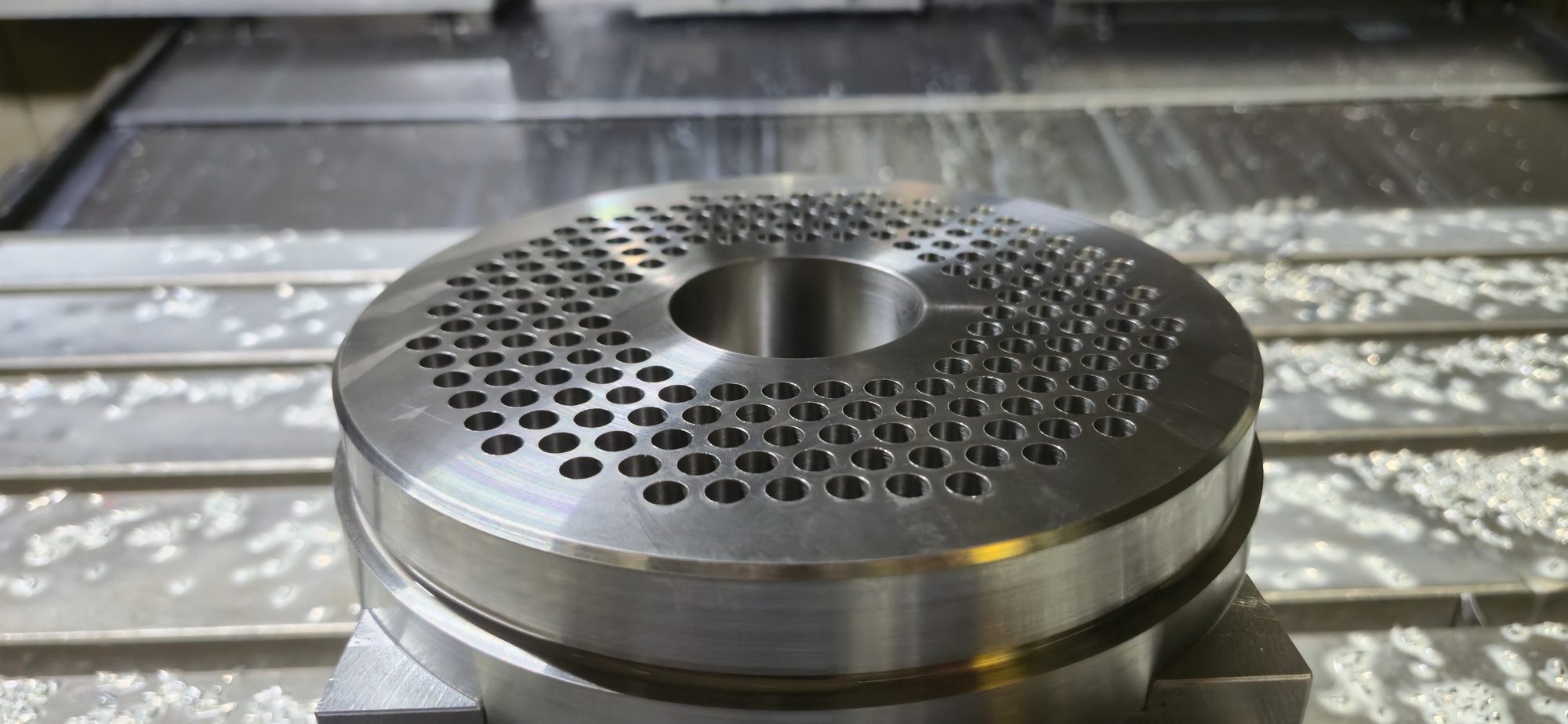
Finished hole pattern and centre bore on the mill table.
A breaker plate sits at the end of the extruder barrel, between the tip of the screw and the adapter or die. It is a thick, round steel plate drilled through with a pattern of holes, and every pound of melt the line makes passes through it.
Filter screens stack against the upstream face of the plate. The screens catch contaminants, gels and unmelted material. The plate supports them against the full melt pressure so they do not blow through.
The resistance of the plate and the screens raises the pressure in the barrel. That back pressure improves mixing and melting, and sends a more even melt into the die.
Melt leaves the screw turning with it. Passing through many small, parallel holes breaks up that rotation, so the flow enters the adapter and die straight and steady.
The plate is clamped between the barrel and the adapter, and its faces help seal that joint. That is why flatness and the fit of the outside diameter matter as much as the holes.
A plate with rough, tapered or burred holes adds pressure drop, holds degraded material and tears screens. A face that is not flat leaks. We drill every hole with through-coolant carbide, break the hole edges and finish the faces, so the plate seals and the screens seat flat.
Five steps from your drawing, or your old plate, to a plate on your extruder.
A PDF, DWG, DXF, IGES or STEP file, or the worn plate itself.
RFQs are reviewed in one to two business days. Simple plates are quoted in one to two days.
Turned, faced, drilled and counterbored to your print.
Critical dimensions are checked before the plate ships. Material certs and inspection reports on request.
Freight or courier, or pick it up in Hillsborough.
Heat treating and plating go to vendors we have used for years, and the plate comes back here to be finished to size.
The largest plates we have made are 20″ in diameter and 4″ thick, for very high pressure extruders, cut from 15-5 PH H950. Anything under that is standard work here.
There is no minimum order. One plate to get a line running is a normal job, and so is a set of spares for the shelf.
Many lines filter the melt through a screen changer rather than a fixed screen pack. The screens can then be changed without taking the extruder apart. In these set-ups the breaker plate often sits in a screen changer adapter instead of directly in the barrel.
The adapter joins the extruder to the screen changer and the die. It holds the breaker plate in a machined recess, carries the melt channel through, and has to seal on both sides. The plate and the adapter have to match each other exactly, or the joint leaks and the screens do not seat.
We machine screen changer adapters and the breaker plates that go into them, to your drawing or from the worn parts you send us. For the other parts around the drive, see our extruder components page.
The figures behind the plates we make.
| Diameter | up to 20″ |
| Thickness | up to 4″ on a 20″ high-pressure plate |
| Holes per plate | up to 1,600 |
| Smallest hole | 1mm (.039″) |
| Hole depth | up to 30 times the hole diameter |
| Drilling | through-coolant carbide drills, high-pressure coolant on every CNC |
| Materials | 15-5 PH (H950 for high pressure), 17-4 PH, 300 and 400 series, tool and alloy steels, Inconel, titanium |
| EDM | through a partner EDM shop when a feature needs it; all machining done here |
| Minimum order | one plate |
Yes. Send us the old plate. We measure every feature and make a new one.
We drill them, with through-coolant carbide drills and high-pressure coolant. When a feature really needs EDM, we work with an EDM shop and do all the machining ourselves.
One. Single plates and small sets are normal work for us.
Down to 1mm (.039″), at depths up to 30 times the hole diameter.
Yes. Tell us what you want and we machine it to your numbers.
Yes, to your drawing or from the plate that came out of it.
Whatever you specify: material certs, first article inspection, inspection reports, on our form or yours.
It supports the screen pack against melt pressure, builds back pressure for better mixing, straightens the flow coming off the screw, and helps seal the joint between the barrel and the adapter or die.
Yes. We machine screen changer adapters and the breaker plates that go into them, to your drawing or from the worn parts.
Breaker plates sit between the screw and the die. These are the services around them.
Send us the drawing, or send us the old plate. We’ll come back with a price and a lead time.